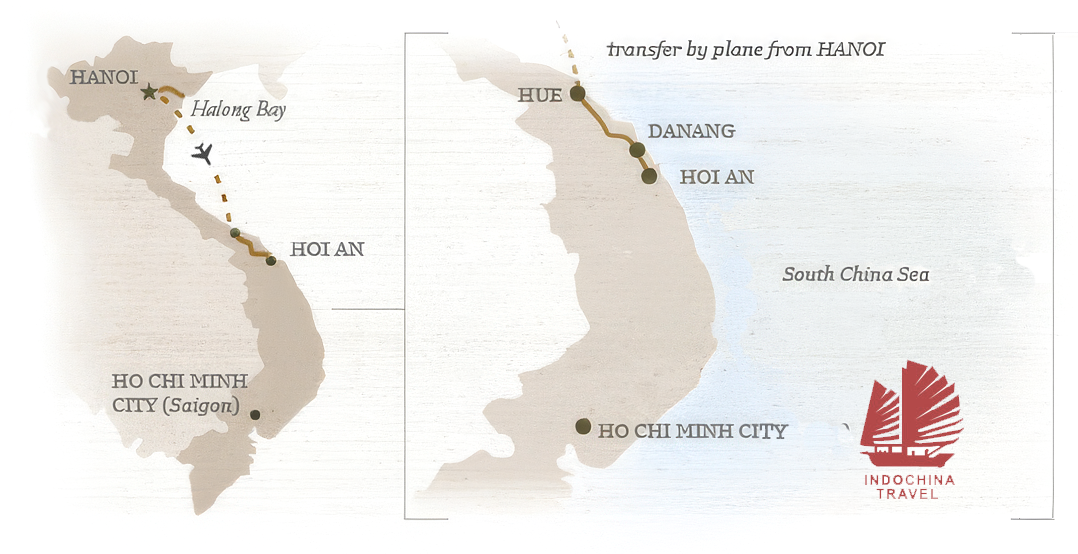
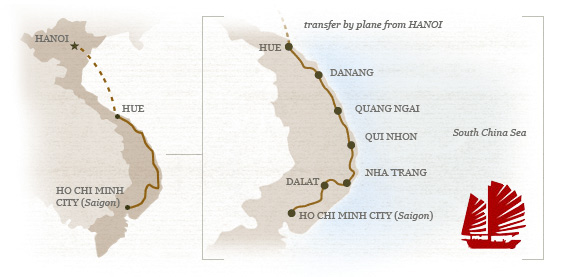
With over three thousand limestone and dolomite islets sprinkled over an area of 1,500 square kilometers, Halong Bay is an unsurpassed wonderland of karst topography. In recognition of this, in 1994 Halong was designated a UNESCO World Heritage Site. Legend has it that when the Vietnamese were under attack long ago, a dragon came to their aid, splitting mountains to impede the progress of the enemy. The limestone topography was created by the lash of the dragon's tail as it thundered down from the mountains to the sea; consequently, "Vinh Halong"—Halong Bay—means "Bay of the Descending Dragon." In geological terms, the mythical monster at work here is wind and water, weathering the porous limestone over a few million years. This process created the bizarre limestone cathedrals, colonized by stunted and twisted vegetation. The romantic setting of rugged island peaks and bays dotted with sailing junks has inspired a whole genre of Vietnamese painting.
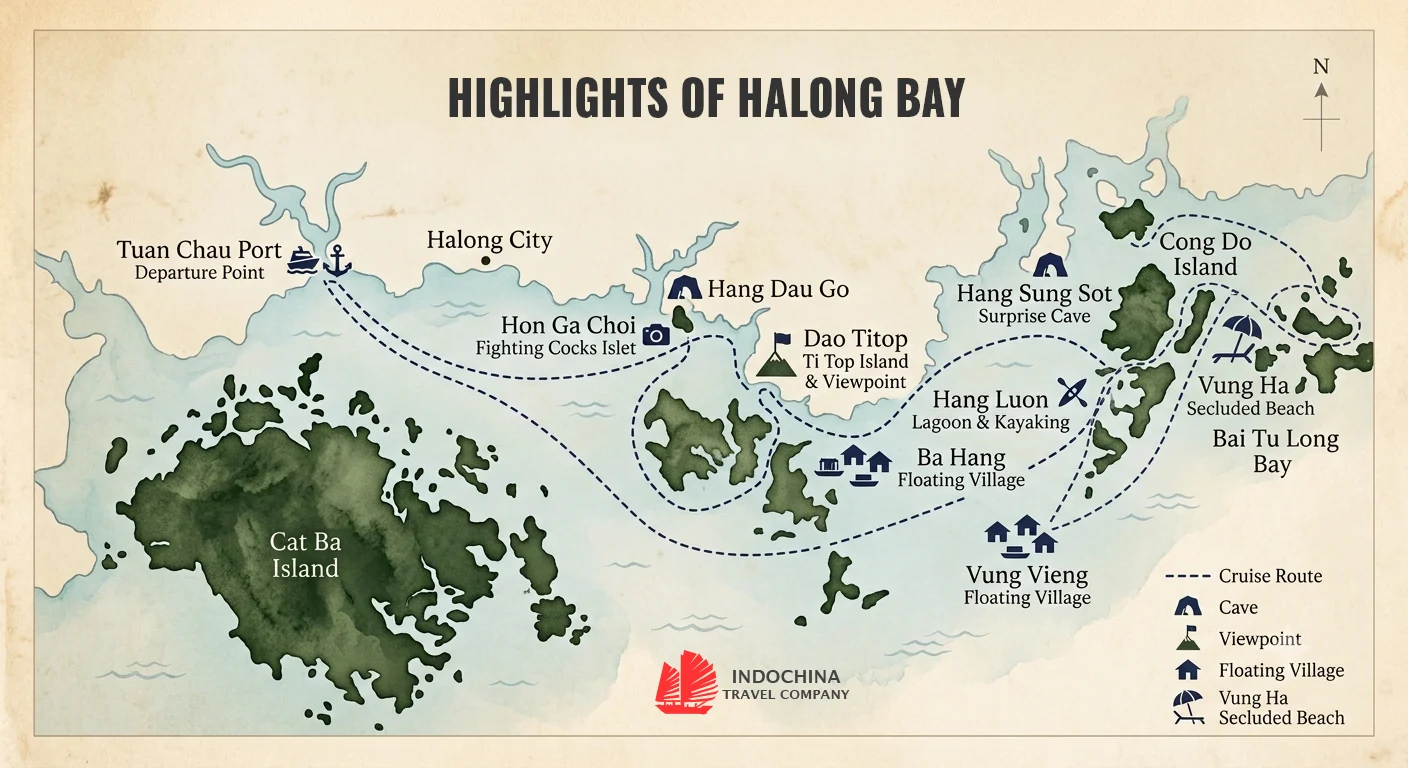
Halong Bay highlights & touring map
Halong Bay touring map.

Naming the Islets

Depending on which kind of beer you drink, the islets resemble animals or other shapes. Some have been christened Head of Buffalo, Neck of Horse, Fighting Cock Rock, Elephant, Crocodile Rock, or Duck Island, while others are called Black Cloud Island, Teapot Island, or Riceball Peak. You can indulge in the fine sport of naming the features yourself, as the French did in their time. The fisherfolk of Halong navigate by these landmarks and can reel off every nook and cranny by name—Hon Ga Choi (Fighting Cock Rock), Hon Con Coc (Toad Island), Hon Rong (Dragon), Hon Rua (Tortoise), Hon Dua (Buddha Praying Island). To follow Vietnamese names, hon means karst peak or islet, dao means larger island, hang means grotto, and dong means karst cave.

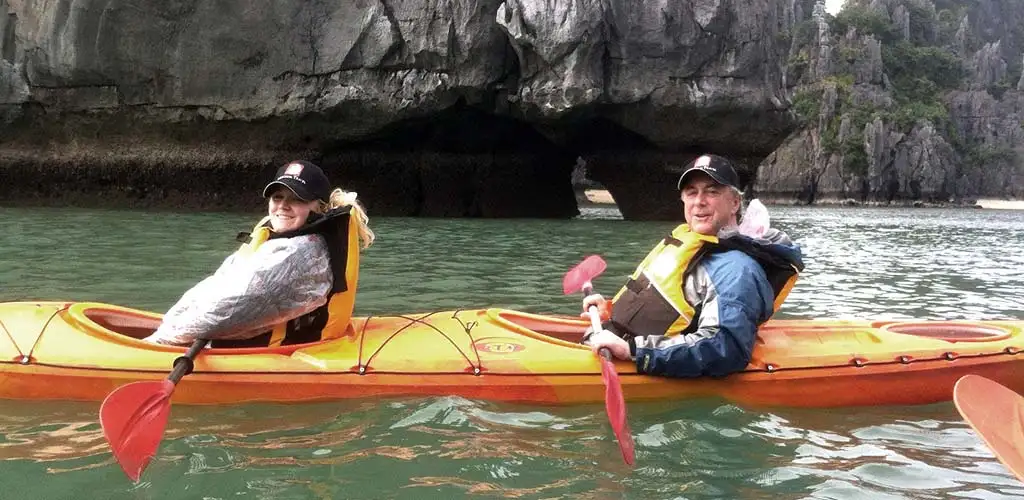
Kayaking on Halong Bay
Kayaking among Halong Bay's limestone towers.

Halong Bay allows you to see its geology from the inside—from grottoes with stalactites and stalagmites. This is a spelunker's paradise, with some very deep caves. Grottoes are prime places for shrines in Asia; Vietnamese and Asian visitors as well as locals pay their respects at Dau Go and Trinh Nu grottoes, among others. On a boat tour, you mainly view these karst grottoes. Otherwise, you relax on board, sunbathing, taking in the views, taking photos of the islands, eating seafood, or gazing at the sails of a junk heading off into the sunset. Sheltered sandy coves on the islands offer good swimming in summer. The beaches themselves are not the fine-sand variety, more often graveled or pebbly, or with sharp shells. Halong Bay holds great potential for snorkeling, diving, and kayaking. Bring your own equipment; rental possibilities are scarce.

Junk Sails on Halong Bay

Fishermen at Halong mount fan-shaped Chinese junk sails on their boats (which is our logo), the same sort of sails once deployed by pirates in these waters. Junks have been used for centuries by the Chinese, Japanese, and Javanese for fishing and transportation, and often as living quarters; a junk commonly includes a deck, high masts, and several cotton sails. Halong is one of the last places where junk sails are still handmade by families of sailmakers. Coarse cotton panels are sewn together with silk thread—every seam sewn by hand. To discourage rot and mildew, the completed sail is dipped in a liquid that comes from a beetroot-like member of the yam family. The sail is dipped and dried three or four times; a process that gives it its dark red-tan color. The sails are braced flat by bamboo strips or battens. The bamboo must be treated for a quite different problem—bamboo parasites can literally shred the wood while at sea. Bamboo may be treated with Japanese lilac leaves, pounded into a paste with lime and seawater. Lacquering can also render bamboo less susceptible to borers.

Private cruise ship on Halong Bay

Dau Go Island

On the north side of this island, about 40 minutes out from Bai Chay, are two deep grottoes, Hang Dau Go and Hang Tuyet. Hang Tuyet (Snow Cave) is also known as Hang Thien Cung (Celestial Palace). As a fairly recent discovery, it has thus far escaped the plague of graffiti and garbage. The large cave has a steep entryway. Be careful in here; you'll need a strong flashlight. Sparkling stalactites hang throughout the cave, glittering like diamonds.

Nearby Hang Dau Go (Hiding the Timber Cave) is the largest grotto in the Halong area. The first French tourists who clambered ashore in the late 19th century christened it Grotte des Merveilles. Its three large chambers contain numerous stalactites and stalagmites in the shapes of birds and animals. One chamber holds a freshwater pool. The grotto especially appeals to Chinese tourists, who love to take photos here and engrave their names on the walls.

Halong Bay has been the setting for some famous naval battles. On three separate occasions in the maze of channels between Haiphong and Halong the Vietnamese prevented the Chinese from landing. In 1288 Tran Hung Dao stopped Mongol ships from sailing up the Bach Dang River by placing steel-tipped bamboo stakes at high tide. The ships ran against them at low tide and sank. General Tran Hung Dao supposedly hid the bamboo stakes in Hang Dau Go when preparing to fight the Mongols.

Private family tour dining on beach on Halong Bay, Vietnam
Private beach cove dining on Halong Bay.

Bo Hon Island

Bo Hon lies about 90 minutes cruise from Bai Chay (one hour on a faster boat) and has seven of the best grottoes and caves in the Halong area within easy reach of each other. The French called the place Ile de la Surprise. Allow at least six hours to get out to the area, explore, and return to Bai Chay.

In a small islet off Bo Hon you'll find Hang Bo Nau, or Pelican Cave, apparently at one time frequented by these birds. This grotto has a deep water entrance, so tour boats can dock up close. Hang Bo Nau consists of a short cave with no exit. From inside the grotto you can take a classic photo of the facing bay, framed by the mouth of the cave, with stalactites hanging down like giant teeth.

Bo Hon Island faces Bo Nau, and a five-minute cruise will put you into a wide semicircular bay. The area holds a sea-level shrine, and two caves high up on cliffs. One cave is not accessible directly from the shore. A set of steps ascends 50 meters to the other, called Hang Sung Sot. Hang Sung Sot is very deep, with sparkling white stalactites. A one-hour hike will take you through it. If we continue eastward by boat around Bo Hon Island for about 20 minutes, you'll reach Hang Luon, a perfectly circular pool accessible by a cave entrance by boat.

Traveler learning to fish on Halong Bay, Vietnam

Coming around the back of Bo Hon Island, a half-hour cruise will get you to a smaller island with a sea-level cave called Hang Trinh Nu (Virgin Grotto). Hang Trinh Nu is associated with a legend about a poor fishing family who rented a boat from a rich mandarin. When they could not pay what they owed him, the cruel mandarin demanded the hand of their exceptionally beautiful daughter. She refused to marry him, so he ordered his soldiers to seize her, but she escaped by boat and hid in Hang Trinh Nu.

Recent Cave Discoveries

Within range of Hang Trinh Nu are some pristine mid-1990s discoveries. Spurred by overcrowding at other caves, fishermen were offered rewards for blazing trails to new caves to ease the congestion. Locals have rights to charge entry if they set up walkways and illuminate the caves with generator lighting. Slightly west of Hang Trinh Nu is Dong Me Cung (Grotto of the Labyrinth), a deep cave with sparkling stalactites. Farther east lies Dong Tam Cung (Three Palaces), which qualifies as the most spectacular cave at Halong Bay with three magnificent chambers, well illuminated, with a fantasy landscape of limestone forms.

Cat Ba Area

The coves around Cat Ba are riddled with oddly shaped karst formations. A well-known beach here is Ba Quy Dao (Three Peach Beach), so named because of three rock outcrops resembling peaches. You can easily visit these areas on a chartered boat originating in Cat Ba Harbor (Cang Cat Ba), on a day trip, or connecting from Cat Ba to Bai Chay.

Halong Bay's Hidden Caves

Fishermen have explored every nook and cranny of Halong Bay. Or have they? Karst islets may be hollowed out in parts of the interior. Some parts are accessible through grottoes and some can be explored by small boat at low tide. This is the way to enter Ho Ba Ham (Three Tunnel Lake) on Dau Be Island, and Hang Hanh Grotto, between Ha Tu and Campha. But there are probably many more tidal caves waiting to be explored.

Preliminary exploration at Halong Bay has revealed the presence of expansive hong systems, often interconnected by caves hundreds of meters long. Around Halong Bay and Cat Ba are limestone labyrinths filled with caves, lagoons, arches, and rock gardens. Unfortunately, the cave systems at Halong Bay are deceptively dangerous—even slack tides create a difficult current.

Dau Be Island

One hour south of Hang Trinh Nu, or three to four hours out of Bai Chay, lies Dau Be Island, which has a small fishing settlement. To the western side of the island is Ho Ba Ham (Three Tunnel Lake), a deep grotto with three inland "lakes." You can access it only at low tide in a small rowboat; locals will offer to take you through. The tunnels flood at high tide and become very dangerous, so pay attention to the time and the turning tide. Dau Be Island features sandy coves excellent for swimming, also good diving spots with lots of coral.

Hong Gai Area

You can visit Hong Gai by boat, coming in close to the fishing trawlers that form their own kind of floating market in the morning. You can arrange to alight here to check out the onshore market in Hong Gai. Nearby, tucked away in an alley, is Long Tien Pagoda, named after the illustrious dragon; it's guarded by statues of mythical warriors in elaborate coats of armor. A short way out from Hong Gai is Hon Can, the island portrayed in the film Indochine as Ile du Dragon.

East of Hong Gai

Adjacent to Halong Bay stretches Bai Tu Long Bay, accessed from Campha, another coal-mining area, or Hong Gai. Far from the crowds, Bai Tu Long Bay waits to be explored. A full day itinerary from Hong Gai eastwards might take in Hon Oan, Hon Dua (Buddha Praying Peak), Hon Reu (Monkey Island), and Cua Ong Pagoda. Hon Reu, a soil island about four hours from Hong Gai, supports up to 100 monkeys.

Located between Ha Tu and Campha, Hang Hanh is the spelunker's special—a tunnel of several kilometers accessible only on certain days of the month when the water level at the tunnel entrance is optimum. Hang Hanh is unique among the caves of Halong Bay in the diversity and size of its stalactites and stalagmites.

Pearl prospecting thrives on Dao Co To. Off some islands lie rich abalone grounds—mother-of-pearl obtained from the shells is used in making Vietnam's lacquerware. On far-flung islets, daring climbers collect sea-swallow nests, highly prized for use in medicinal soup.

Bai Chay

Bai Chay and Hong Gai serve as the twin jumping-off points for boat trips to Halong Bay, located 165 kilometers by road from Hanoi and 60 kilometers from Haiphong. Officially, these two places are called Halong City West and Halong City East, but nobody refers to them by these names. Bai Chay and Hong Gai sit on facing slabs of land, connected by a car ferry that operates 24 hours.

Hong Gai is an industrial coal-mining town, and boats must be summoned from Bai Chay for tours. Hong Gai is also more business-oriented with banking, a post office, and a fair sprinkling of shops. Passenger ferries from Haiphong land in Hong Gai.

Climate — When to Go

Halong Bay is possible year-round although the weather certainly influences tourism at Bai Chay, Hong Gai, and Halong Bay. The best weather on Halong Bay is typically from October through April, with clear skies and pleasant temperatures. In the months of December, January and February, the weather on Halong Bay is typically cool, drizzly and overcast with low visibility but nonetheless is enchanting and moody. In the July-August high season, visitors pack hotels and Bai Chay Beach. Crowds taper off during the shoulder seasons of April-June and September-November, with October typically offering nice weather. During summer months (May to September), tropical storms are frequent and tourist boats may have to alter itineraries depending on weather conditions. During the November 15 to March 15 low season, the weather becomes colder, foggier, and more prone to rain, reducing visibility in Halong Bay. However, there's more availability for private boats. The coldest months for weather on Halong Bay are January and February.

More About Halong Bay

Plan My Halong Bay Trip