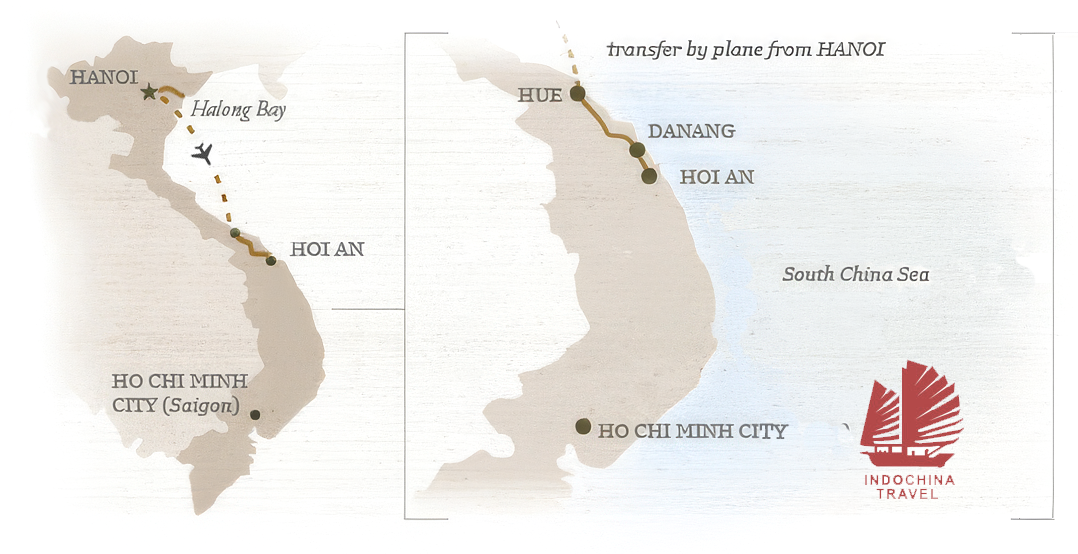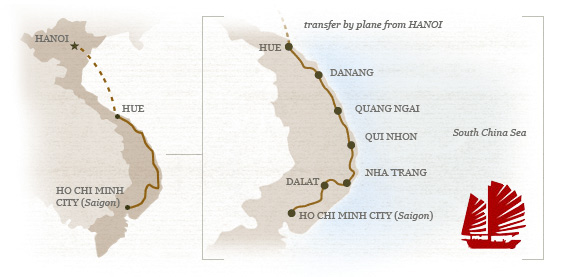

Are the tunnels of Cu Chi, Saigon's most popular tourist site, worth a visit? Definitely consider skipping if your stay in Vietnam or Saigon is limited, or if you have time to see the ones near Hue. Derided as kitschy and a symbol of "war tourism" replete with mannequins and a firing range, nonetheless the Cu Chi Tunnels are Saigon's, and indeed Vietnam's, most popular day-trip destination along with the nearby colorful Cao Dai Great Temple at Tay Ninh. Note that the massive underground complex is not what you will see (which no longer exists), but a short tunnel replica. Rather, consider the vibrant Mekong Delta and the unique river life on the waterways, including floating markets and cycling village footpaths.
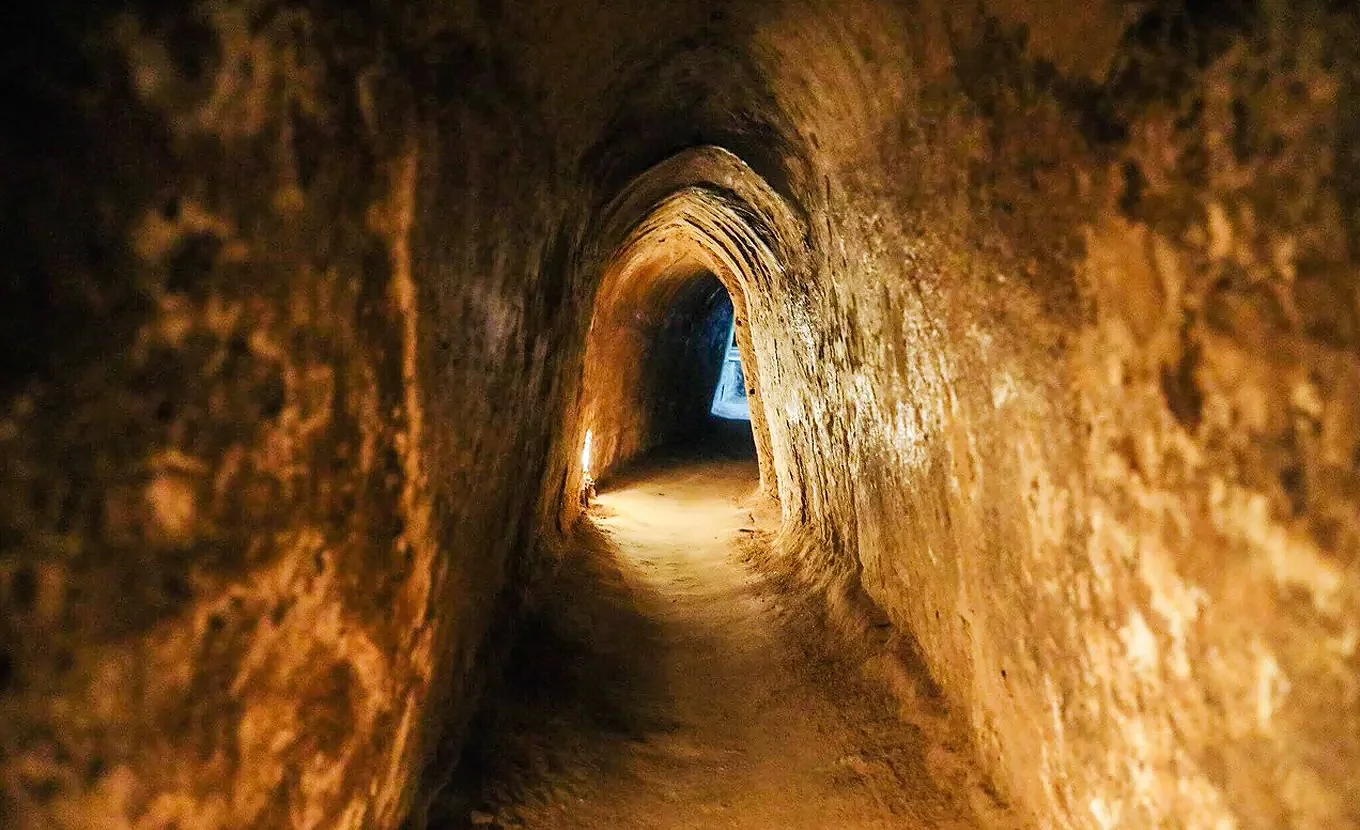
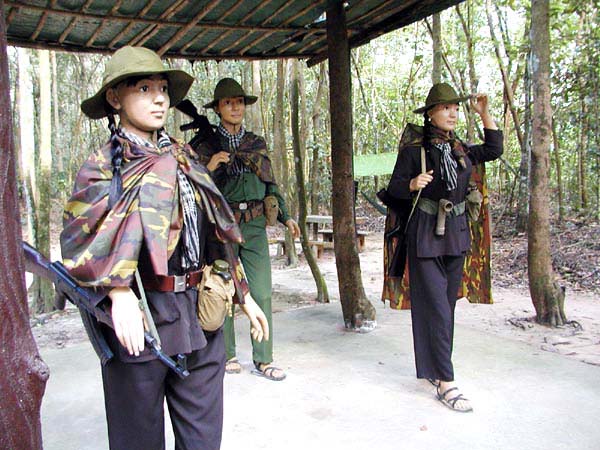
The Cu Chi Tunnels are situated near the village of Ben Suc, about 50 miles northwest of Saigon, and some 25 miles from the town of Cu Chi itself. The tunnels were part of a legendary underground network of small passages that zig-zagged from the southern tip of the Ho Chi Minh Trail near the Cambodian border to the Saigon River. Most Viet Cong tunnels in the Cu Chi area have been destroyed, sealed, or decayed by annual monsoons and flooding, but a few passageways were enlarged to accommodate Western tourist bodies.
During the war, the Viet Cong would crawl on their bellies through the dark, dank tunnels, but visitors can walk through them (albeit hunched over). After scrambling through the tunnels for a claustrophobic, sweaty 15 minutes, you'll wonder how anybody could last a day in the tunnels, let alone a year. Below ground was a complete system of kitchens, rudimentary clinics and operating rooms, meeting rooms, and sleeping chambers with bamboo beds. An underground community developed, with people getting married and women giving birth down below. The network also incorporated storage chambers for weapons and rice, drinking wells, ventilation shafts, false tunnels, and booby-trapped passages.
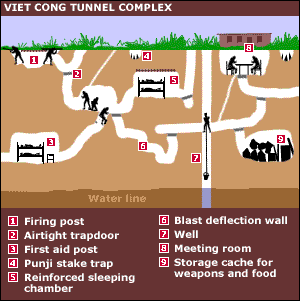 The Vietnamese spent decades digging in the reddish brown laterite clay; the tunnels were all built with simple hand tools. Up to 30 miles of tunnels were constructed by the Viet Minh fighting the French between 1948 and 1954. Between 1960 and 1965, their successors, the Viet Cong, added an astonishing three-level network four times as big, bringing the total up to over 120 miles. The deepest layer of tunnels lay 36 feet underground. Up to 16,000 guerrillas could live in the tunnel complex at any one time, though 5,000 to 7,000 was the normal complement.
The soil at Cu Chi was perfect for tunneling: the clay was sticky, allowed some air penetration, but did not crumble, and proved remarkably stable. The Viet Cong employed ingenious camouflage to conceal tunnel exits, entrances, and ventilation holes. A question that immediately springs to mind is what did they do with all the dirt collected from all that digging? The Vietnamese, intimate with the lay of the land, never left earth from the tunnels in mounds or near a tunnel site. Instead, it was smuggled out in small quantities and recycled into house basements or other structures, poured into streams, and dumped in recent bomb craters.
Củ Chi Tunnels: a masterpiece of guerrilla ingenuity and resourcefulness

Dug by hand with simple tools, often just hoes and baskets, the vast network stretched over 150 miles through incredibly hard laterite clay. The design was complex and multi-layered, often featuring three distinct levels that connected living quarters, hospitals, kitchens, and command centers. The tunnels were deliberately narrow and twisting, designed for the smaller stature of the Vietnamese soldiers, making them difficult for larger American troops to navigate. Defensive engineering was paramount; the system included cleverly camouflaged entrances, intricate booby traps, and special ventilation shafts disguised as termite mounds or natural foliage to provide air without revealing their location. Some passages were even rigged to be flooded, effectively sealing off sections from intruders and demonstrating a sophisticated understanding of structural and tactical design under extreme pressure.
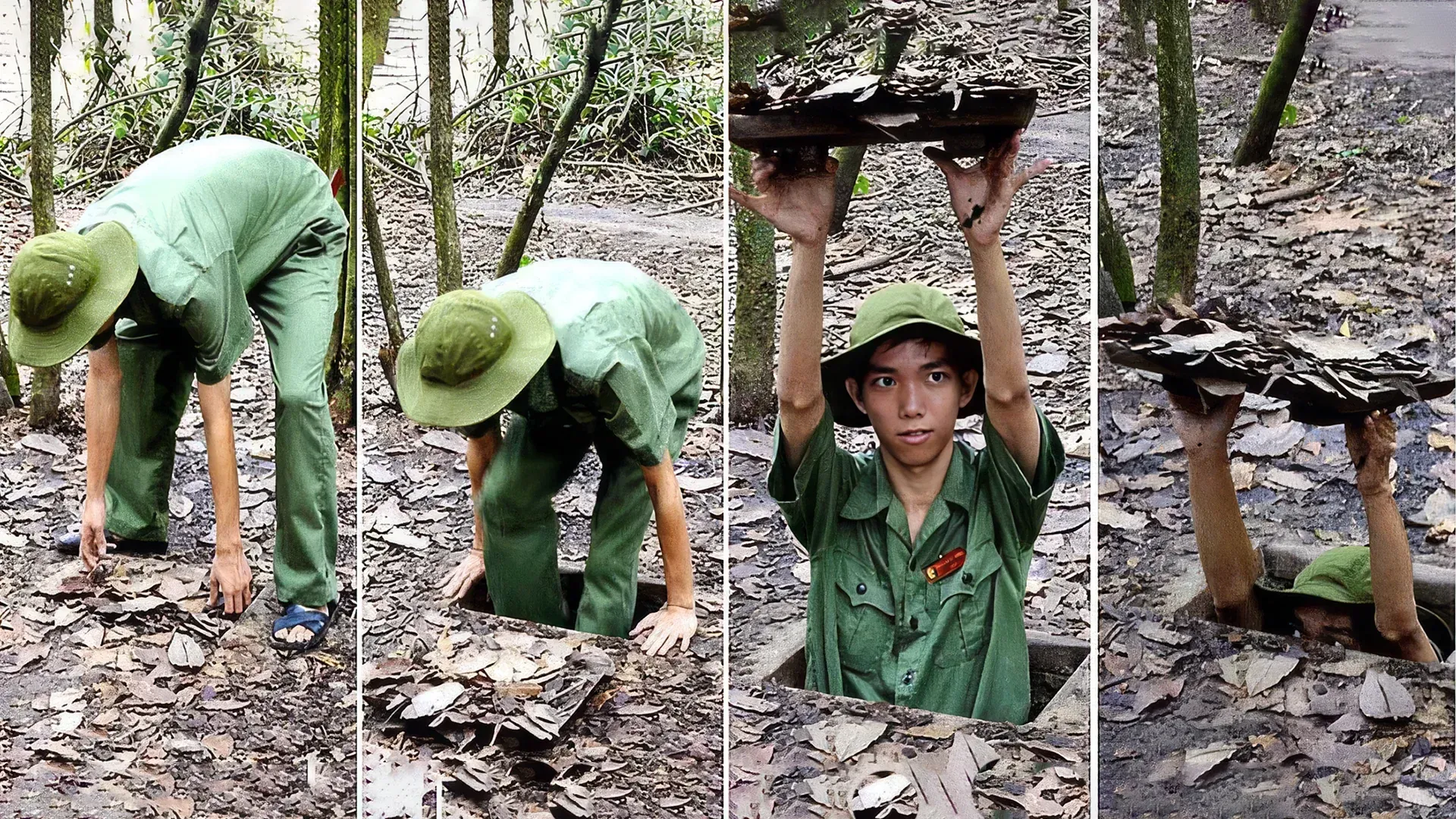
The tunnels were key to Viet Cong success, providing a stronghold close to Saigon. Against superior American firepower and technology, the Viet Cong had the element of surprise. By the time U.S. troops arrived they faced an army of moles: guerrillas could pop up a trapdoor, fire away, and be back down the hatch before the U.S. soldiers could react.

Nor was it easy to destroy the VC "subway." United States forces declared Cu Chi a free-fire zone and dropped nearly 50,000 tons of bombs on the region, but the tunnels continued to operate. Blowing gas or pumping water into the tunnels also proved ineffective, as each section of an important tunnel could be sealed off. The United States formed squads of "tunnel rats"—slim, small-bodied men who probed tunnels (above)—and sniffer dogs were also used.
I could smell the Viet Cong, really, I could smell Charlie. It wasn’t just his body sweat or the urine. There were times when I could hear the breathing, real quiet; you could hear a person breathe, and I’d know he was in there, and I didn’t go any farther. I just said to myself: ‘In this dark corner of a tunnel is where the animal belongs, a rodent belongs. I’m becoming like a rodent, but still I don’t belong.’ Yes, I could smell Charlie.
And he knew me. The type of cologne I used, the aftershave—that’s when we stopped using it altogether. But there was more than that. There was the scent that told you there was somebody in the tunnels. We became so tuned up after a while that when the other person would flick an eyelid up or down, you really knew he was there, in the corner, not even hiding anymore. Just sitting and waiting. They were the ones you never killed. You just backed out and told them up above the tunnel was cold.
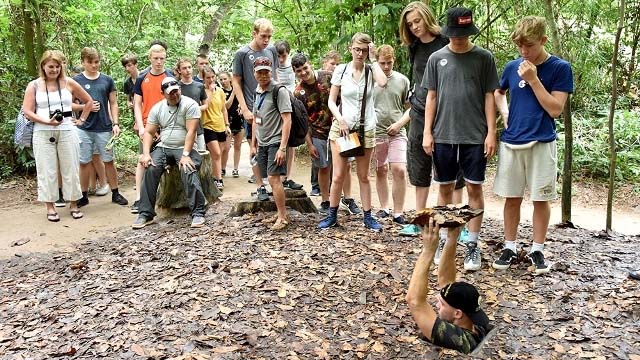 The current Cu Chi Tunnels site is very popular but also very commercial (dubbed "Cong World" by a visiting Western reporter).
Souvenir shops sell war-related paraphernalia — you can buy a genuine pair of rubber sandals in the style worn by soldiers on the Ho Chi Minh Trail. Attendants at the shops wear black pajamas and rubber sandals, just as the Viet Cong did.
After crawling around in the tunnels, visitors may, at a nearby firing range, empty an AK-47 or M16 or other vintage rifles at targets, but be warned that the noise can be deafening.
Day Trip Itinerary to Cu Chi by Private Car
Depart Saigon after breakfast with enough time to allow for reaching Tay Ninh in time for the noon Cao Dai service. We then depart for the Cu Chi Tunnels and are usually back in Saigon mid-afternoon. A trip only to Cu Chi will place you back in Saigon by about lunch (or we may organize a picnic in Cu Chi if you are running late departing Saigon in the morning).

Cu Chi Tour by Speedboat Itinerary (with private boat charter)
- 8:00 AM — Pick-up at hotel and transfer to the boat jetty in District 1
- 8:15 AM — Private boat departure to Cu Chi
- 9:30 AM — Arrive in Cu Chi
- 11:30 AM — Finish touring. Lunch at a delightful local cafe
- 12:30–1:00 PM — Depart by private car to Tay Ninh, visiting the Cao Dai Great Temple, or return directly to central Ho Chi Minh City / Saigon